The 2026 Home Elevator ROI Framework: Resale, Safety, and Smart Integration
Choosing a home elevator means weighing financial impact, safety standards and technological capabilities, all while navigating a market where quality varies dramatically. For luxury homeowners planning multi-generational living spaces, custom home builders designing accessible properties and residential architects specifying design features, the stakes are high. A misstep can mean compromised safety, poor resale returns or a system that's obsolete within years.
The 2026 Home Elevator ROI Framework offers a clearer path forward. This framework evaluates home elevators through three interconnected pillars — resale value, safety compliance and smart integration. Rather than treating these as separate considerations, the framework shows how they work together to create long-term financial returns and peace of mind.
This guide walks through each pillar, providing the technical knowledge and market insights needed to make a confident decision.
What Is the 2026 Home Elevator ROI Framework?
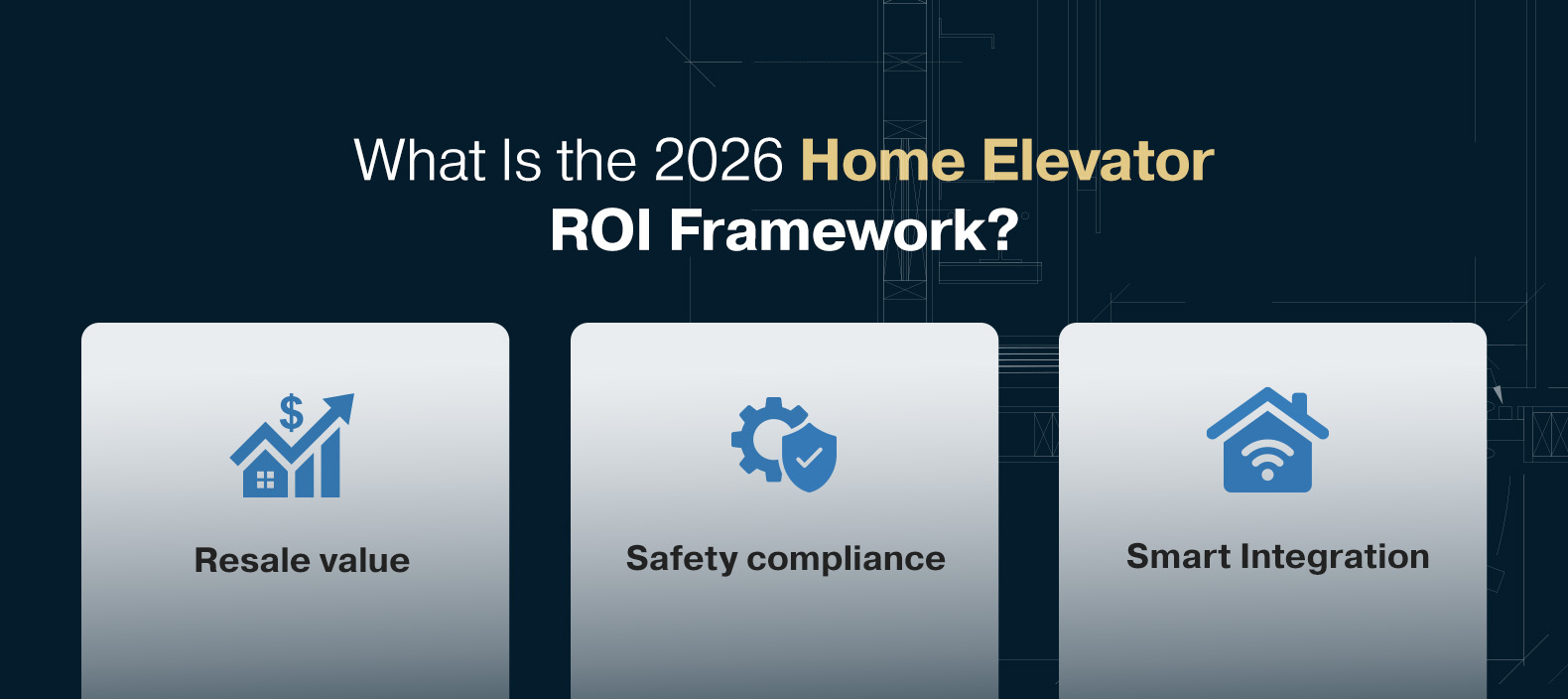
The framework redefines how luxury homeowners, builders and architects evaluate home elevator investments. Rather than viewing elevators solely as accessibility solutions, this approach positions them as strategic assets that deliver measurable returns across three dimensions:
- Resale value: This pillar addresses the financial return on your investment. As multi-generational living arrangements become more common and buyers prioritize homes that accommodate long-term occupancy, elevators have shifted from niche amenities to valued features that command premium pricing in competitive markets.
- Safety compliance: Compliance ensures your installation meets or exceeds current regulatory standards. Ensuring compliance protects users and your investment, as noncompliant systems can create liability exposure and reduce property marketability.
- Smart Integration: Leveraging technology can reduce operating costs, improve reliability and ensure your system remains current as home automation standards evolve. It isn't about adding luxury features for their own sake. Technology serves as a practical tool for the efficiency and seamless operation that buyers increasingly expect in premium properties.
When these three pillars work together, they create an investment that enhances both immediate quality of life and long-term property value. For those embracing aging-in-place planning, the framework provides confidence that your home will meet your needs for decades while remaining attractive to future buyers who value the same features.
How Home Elevators Increase Resale Value
The financial case for home elevators has strengthened significantly as market dynamics shift. Three factors drive this trend: professional valuation practices, demographic demand and the mathematics of return on investment.
Understanding an Appraiser's Valuation
Real estate appraisers and the National Association of Realtors assess home elevators as significant structural improvements that can move properties into higher value brackets. Industry professionals recognize elevators as features that can expand the potential buyer pool, particularly in markets where accessibility and convenience rank among the top purchasing criteria.
Appraisers evaluate elevators based on several factors, including:
- Quality of installation.
- Integration with the home's design.
- The presence of modern safety features.
A professionally installed system that surpasses current code requirements commands a higher valuation than older installations or systems that appear as afterthoughts rather than integrated design elements. The key distinction lies in how the elevator fits within the property's overall value proposition. In luxury markets, elevators contribute to the narrative of a well-appointed, thoughtfully designed home. In multi-generational housing contexts, they represent practical solutions that extend the home's usability across different life stages.
Aging-in-Place and Universal Design
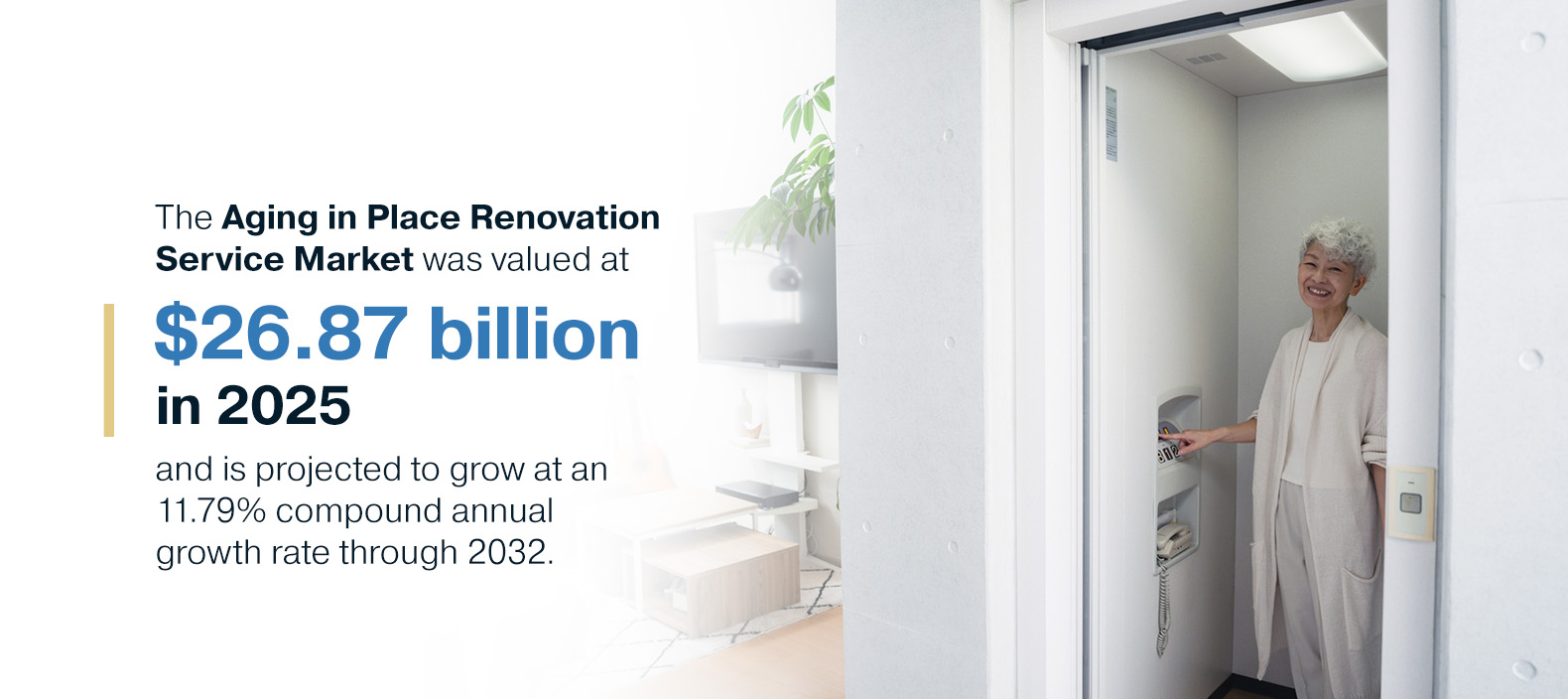
Home elevators are increasingly popular solutions for aging in place because they allow seniors to access all levels of multistory homes without relocating. The Aging in Place Renovation Service Market was valued at $26.87 billion in 2025 and is projected to grow at an 11.79% compound annual growth rate through 2032. This growth reflects a fundamental shift in how homeowners approach long-term residence planning.
Universal design principles, exemplified by home elevators, have moved from specialized accommodations to mainstream features that appeal to buyers across age groups. These principles emphasize spaces that function effectively for all users regardless of physical capabilities. ADA compliance standards, originally developed for commercial spaces, increasingly inform residential design decisions as buyers recognize the practical advantages of accessible features.
For sellers, this translates to a broader buyer pool. Homes with elevators appeal not only to those with immediate mobility considerations but also to buyers planning for future needs, multi-generational households and anyone who values the convenience of effortless floor-to-floor movement.
Return on Investment
While installation costs vary based on system type, customization level and structural requirements, professionally installed elevators in appropriate markets can deliver meaningful returns by increasing property value.
The cost-benefit analysis extends beyond direct resale returns. Consider the alternative: relocating to a single-story home or moving to assisted living. Relocation costs, including real estate fees, moving expenses and the emotional toll of leaving a long-term home, can exceed the cost of installing an elevator. For many homeowners, the ability to remain in place represents value that financial calculations don't capture.
When evaluating the full cost of installation, factor in both the immediate expense and the long-term savings from avoided relocation and maintained property appreciation. The investment becomes particularly compelling when you consider that well-maintained systems can operate reliably for decades.
Home Elevator Safety and Code Requirements
Safety compliance forms the foundation of any responsible home elevator investment. Understanding current codes and safety features ensures your installation protects users while maintaining its value over time.
The ASME A17.1-2025 Code
The ASME A17.1-2025 code establishes comprehensive requirements for elevator design, construction, installation, operation, inspection, testing, maintenance, alteration and repair. This standard represents the most current thinking on elevator safety and sets the baseline for all new installations.
For custom home builders and residential architects, compliance with ASME A17.1-2025 isn't optional — it's mandatory for user safety and provides essential legal protection. The code addresses everything from structural load requirements to emergency procedures, ensuring that every aspect of the system meets rigorous safety standards.
Working with an elevator manufacturer familiar with current code requirements eliminates the risk of costly retrofits or compliance issues that could surface during home sales or inspections. The code's comprehensive nature means that properly compliant systems incorporate multiple layers of safety protection that work together to prevent accidents.
The 3/4" x 4" Safety Rule
The 3/4" x 4" safety rule addresses the maximum allowable gap between the elevator car door and the hoistway entrance. This specification prevents entrapment.
The U.S. Consumer Product Safety Commission has recalled thousands of residential elevators due to child entrapment hazards in the space between exterior and interior doors. These incidents underscore why precise gap specifications matter. Entrapment prevention ensures that the most vulnerable users remain safe in all operating conditions.
Modern systems achieve this specification through careful door alignment and ongoing maintenance protocols that verify gaps remain within tolerance over the system's lifetime. This attention to detail separates professionally engineered installations from systems that meet baseline requirements without the precision necessary for true long-term safety.
UL-Certified Components
UL-certified components signify independent testing and certification by Underwriters Laboratories, ensuring that each element meets specific safety and performance standards. This certification process subjects components to rigorous evaluation before they're approved for use in elevator systems.
Using UL-certified components means every element, from control boards to safety switches, has been vetted for reliability and safety. They reduce risk and guarantee optimal performance of the integrated system. For homeowners and professionals specifying elevator systems, UL certification provides third-party verification that components meet industry-leading standards.
Other Key Safety Features for Home Elevators
Beyond code compliance and certified components, modern home elevators incorporate multiple active safety systems that work together to protect users:
- Infrared light curtains: These invisible beams cross the elevator doorway, detecting any obstruction in the door's path. When an obstruction is detected, the system automatically halts or reverses the door to prevent injury. This technology provides precise, reliable protection that responds faster than mechanical safety edges.
- Overspeed governors: This mechanical safety system continuously monitors the elevator car's speed and detects when it exceeds its rated velocity. If an overspeed condition occurs, the governor automatically engages braking mechanisms to bring the car to a safe stop. It prevents runaway conditions and ensures controlled movement at all times.
- Automatic rescue devices: These devices provide backup power to safely lower passengers to the nearest floor and open the doors during power failures or system malfunctions. This feature eliminates the anxiety and safety concerns associated with being trapped between floors.
Is Your Elevator Compliant? 5-Point Safety Checklist
- The 3/4" x 4" Rule: Is the gap between the elevator car door and the hoistway door narrow enough to fully prevent an entrapment hazard?
- ASME Code Alignment: Is your current residential lift system engineered and certified to meet modern ASME A17.1 safety baselines?
- Emergency Systems: Does your elevator feature an active backup battery-powered lowering system and functional in-cab phone communications?
- Entry Obstruction Sensors: Are modern infrared light curtains installed to stop doors from closing on objects or passengers?
- Overspeed Defenses: Is a mechanical overspeed governor built-in to immediately halt the cab in the event of velocity threshold failure?
Smart Integration: Modernizing the Home Elevator
Technology transforms home elevators from mechanical systems into intelligent components of the modern home. These advances deliver practical benefits that reduce costs, improve reliability and protect your investment value.
For residential architects and custom home builders, these technologies represent essential features rather than optional upgrades. They ensure that elevator systems remain compatible with evolving home automation standards and continue meeting user expectations as technology advances. Projects that incorporate these features from the design phase demonstrate forward-thinking planning that appeals to discerning buyers.
IoT Predictive Maintenance
The Internet of Things (IoT) in elevator technology refers to integrating smart sensors and network connectivity into lifts to track performance in real time. Connected sensors continuously monitor system performance, identifying potential issues before they cause failures. This approach shifts maintenance from costly reactive repairs to proactive interventions, reducing downtime, lowering spending and extending component life.
For homeowners, this means fewer service calls and greater confidence in system reliability. The data collected also provides documentation of proper maintenance that can enhance resale value by demonstrating responsible ownership.
Regenerative Drives
Regenerative drives capture kinetic energy during descent and feed it back into your home's electrical system. In other words, these reuse energy that would've been wasted. They help reduce operational costs while supporting energy-efficient home elevator operation.
The cumulative savings over an elevator's lifespan can offset a significant portion of your initial investment. In markets where energy efficiency commands premium valuations, this feature contributes directly to resale appeal.
Voice and Touchless Controls
In modern homes where voice assistants and touchless technology are becoming standard, these controls ensure your elevator integrates seamlessly with existing smart home systems. This compatibility matters when selling to buyers who expect their entire home to function as an integrated technology ecosystem.
Beyond convenience and ROI, voice and touchless controls enhance hygiene by eliminating high-touch surfaces.
The Factory-Direct Manufacturing Advantage
Factory-direct manufacturing means one company handles elevator design, production, installation and service. For homeowners focused on maximizing ROI, this matters because direct manufacturer accountability strengthens both safety compliance and documentation of resale value.
When the company that engineered your elevator also installs and services it, quality standards remain consistent throughout the process.
Eliminate the Safety Gap
Addressing this gap matters because elevator safety and performance depend on precise installation that follows manufacturer specifications exactly. When installation teams work directly for the manufacturer, they bring factory training and direct access to engineering support. Issues that arise during installation receive immediate attention from the people who designed the system.
Get Custom Engineering from Day One
Custom installations represent the majority of residential elevator projects. As such, factory-direct manufacturing means your specific requirements inform the engineering process from the start. The team building your elevator understands your home's unique characteristics and can customize solutions rather than forcing standard products into non-standard spaces.
Enjoy Lifetime Support Continuity
Quality assurance extends beyond installation. Factory-direct service means the technicians maintaining your system have complete knowledge of its design and access to original parts without delays or substitutions. This continuity protects your investment over its entire operational life and ensures that warranty coverage remains straightforward and reliable.
Why Trust Residential Elevators?
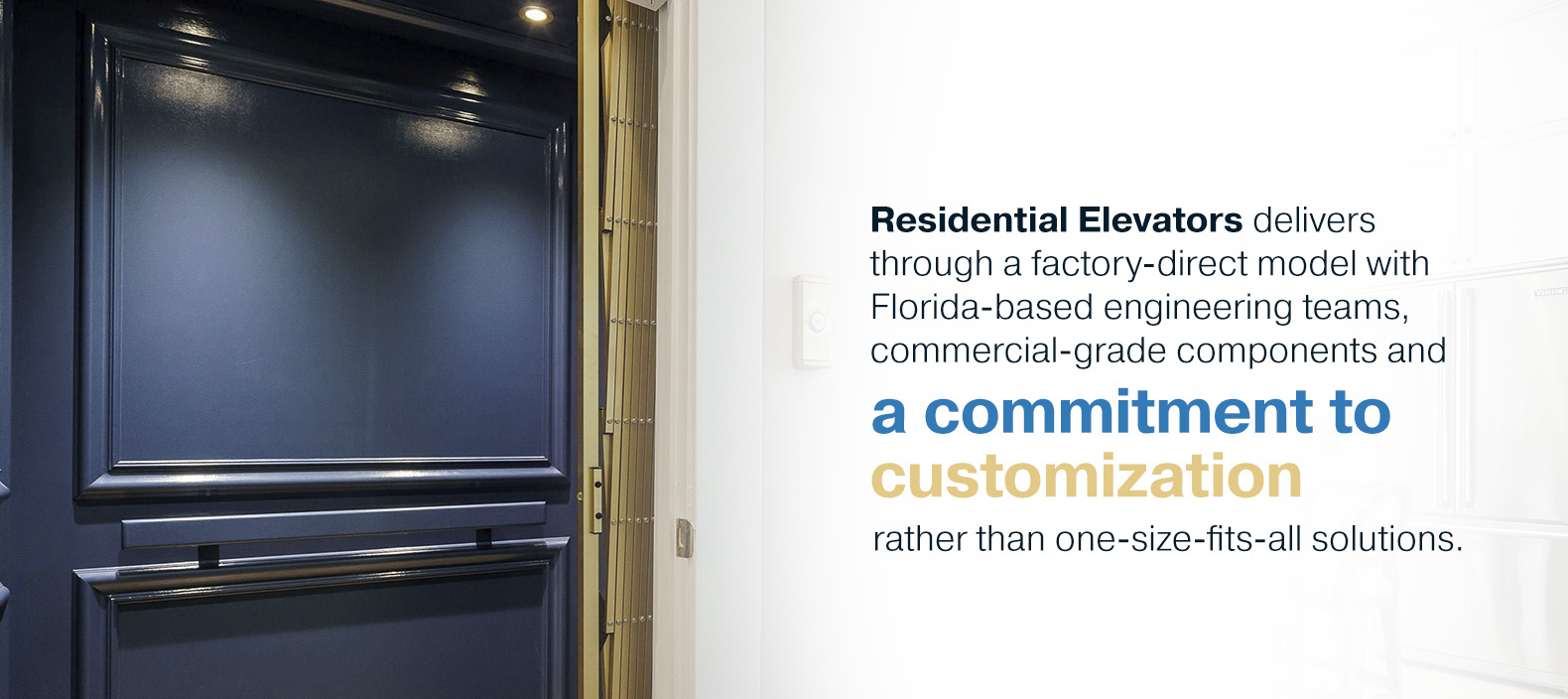
Residential Elevators delivers through a factory-direct model with Florida-based engineering teams, commercial-grade components and a commitment to customization rather than one-size-fits-all solutions. We've helped homeowners and builders get affordable, tailored elevators since 1996.
Every system is built to your exact specifications while exceeding industry safety standards. Our approach ensures the quality and long-term value that your home elevator investment demands.
Design Your Custom Elevator With Residential Elevators
When resale value, safety and technology converge in a single installation, the result is a strategic investment that enhances both property worth and quality of life. Achieving this balance requires a trusted manufacturing partner who controls every phase of production and installation.
Whether you're designing a custom home or adding accessibility features to an existing property, start designing your elevator with our 3D Cab Builder to visualize your options. For builders and architects working on technical specifications, explore our technical planning tools to integrate elevators into your project seamlessly. Our team provides the expertise and support to ensure your investment delivers returns for decades.